A Short History of the Middle East: From Ancient Empires to Islamic State by Kerr Gordon
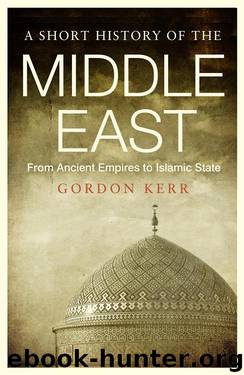
Author:Kerr, Gordon [Kerr, Gordon]
Language: eng
Format: mobi, epub
Publisher: Oldcastle Books
Published: 2016-02-24T16:00:00+00:00
The Second World War
1939-1941
The Middle East became a very important theatre of war during the conflict of 1939 to 1945. Turkey remained neutral, but the new states moulded from the demise of the Ottoman Empire, although non-belligerent, were occupied by participants in the war – Great Britain and France – and were, therefore, involved. The British had similar objectives in the region as they had during the First World War – the retention of India and the safeguarding of the oil facilities in Iran. All seemed well until Italy entered the war on the German side in July 1940. British troops faced Italian forces in Libya and there were Italian garrisons in Eritrea. Egypt was bombed by Italian planes and it seemed likely that the Italians would launch a full-scale invasion of that country. Commonwealth troops from South Africa, New Zealand and Australia were sent in to bolster the British forces.
In September 1940, as expected, the Italians invaded Egypt, making it as far as Sidi Barrani about 59 miles beyond the Libyan border, but the British drove them back to Libya by the end of that year. Reinforced, however, by German troops led by the indomitable General Erwin Rommel (1891-1944), ‘the Desert Fox’, the Axis powers advanced into Egypt in April the following year. After Crete was captured that same month, the British hold over the Eastern Mediterranean was in danger.
Meanwhile, in Iraq, nationalist German sympathisers seized power in March 1941, and Rashid Ali al-Gaylani (1892-1965) became prime minister. His government failed to respond to a request by the British government to move troops across Iraq, contravening the Anglo-Iraqi Treaty, and this meant that the two countries were at war with one another. The Axis forces promised to Iraq were insufficient and arrived late and, with an Indian force landing at Basra, the revolt collapsed. Rashid Ali and his government fled the country.
Syria and Lebanon, meanwhile, fell into the hands of the Vichy government after the fall of France in June 1940. Britain announced that it would not permit the occupation of these countries by the Germans, and when German planes landed at Syrian airfields, en route to help Rashid Ali’s short-lived Iraqi government, the British and the Free French launched an invasion from Palestinian bases. After six weeks’ fighting, the Vichy troops were defeated and an armistice was signed.
1942
Japanese victories in the Far East forced the British to send tanks there from the Middle East, leaving the way clear for Rommel to advance towards Egypt. There was an ambivalent feeling towards the war in Egypt, many believing it had nothing to do with them. German property was seized and German nationals were interned, but there were many in the government who leaned towards the Axis powers. The British High Commissioner persuaded the Egyptian King Farouk to replace dissenters – especially the prime minister, Ali Mahir (1882-1960) – and the king complied, providing minsters more sympathetic to the Allies. Many in Egypt still believed the country should remain neutral, however.
Download
A Short History of the Middle East: From Ancient Empires to Islamic State by Kerr Gordon.epub
This site does not store any files on its server. We only index and link to content provided by other sites. Please contact the content providers to delete copyright contents if any and email us, we'll remove relevant links or contents immediately.
The Vikings: Conquering England, France, and Ireland by Wernick Robert(84606)
Ali Pasha, Lion of Ioannina by Eugenia Russell & Eugenia Russell(40386)
The Conquerors (The Winning of America Series Book 3) by Eckert Allan W(39187)
The Vikings: Discoverers of a New World by Wernick Robert(37051)
Cecilia; Or, Memoirs of an Heiress — Volume 1 by Fanny Burney(32726)
Cecilia; Or, Memoirs of an Heiress — Volume 2 by Fanny Burney(32090)
Cecilia; Or, Memoirs of an Heiress — Volume 3 by Fanny Burney(32068)
Empire of the Sikhs by Patwant Singh(23208)
The Secret History by Donna Tartt(19477)
Hans Sturm: A Soldier's Odyssey on the Eastern Front by Gordon Williamson(18728)
Cat's cradle by Kurt Vonnegut(15565)
Pimp by Iceberg Slim(14805)
Sapiens: A Brief History of Humankind by Yuval Noah Harari(14558)
Norse Mythology by Gaiman Neil(13576)
Talking to Strangers by Malcolm Gladwell(13560)
Leonardo da Vinci by Walter Isaacson(13528)
4 3 2 1: A Novel by Paul Auster(12628)
Underground: A Human History of the Worlds Beneath Our Feet by Will Hunt(12237)
The Radium Girls by Kate Moore(12193)
